
Blog
How Long Does Tongkat Ali Take to Work? A Realistic Timeline
How long does Tongkat Ali take to work? An honest timeline for root tea vs extract capsules, what studies measured, and why week-by-week claims mislead.
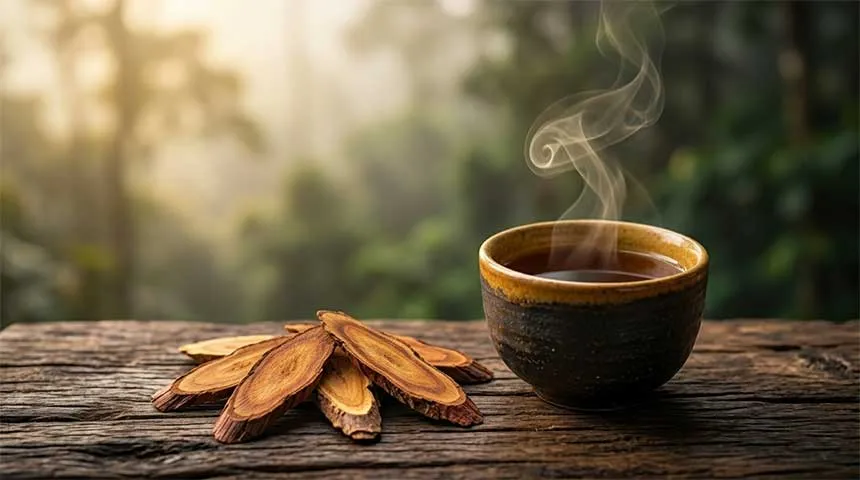
How long does Tongkat Ali take to work? There's no verified timeline for brewed root tea. Human studies have generally tested particular standardized extracts, and their schedules can't predict whether or when an unassayed root tea will produce a noticeable effect.
“Tongkat Ali” isn’t one uniform intervention. A capsule made from a standardized extract, a powdered root, and slices simmered in water differ in manufacture, composition, and serving method — so a study lasting several weeks doesn’t mean you should expect a result after the same number of weeks. Study duration is the period over which researchers collected data, not necessarily the onset time of an effect, and not a guarantee that every participant benefited.
What the Research Can — and Can’t — Tell Us
A 2022 systematic review and meta-analysis examined testosterone-related findings on Eurycoma longifolia extracts and described the evidence as suggestive, while noting differences among studies and the need for stronger research: PubMed 36013514. That review is useful for understanding the state of extract research — it doesn’t establish a universal onset time for Tongkat Ali, a dose or timetable for loose root tea, or that feeling more energetic means a hormone actually changed. It also doesn’t mean the absence of an immediate sensation proves a product is inactive.
The boundary is simple: extract study, root tea, and this batch are three different things. We don’t publish a batch certificate of analysis, DNA identification, or measured eurycomanone concentration — colour, bitterness, aroma, and origin can’t substitute for those measurements. See what we test.
Why Online “Week-by-Week” Timelines Are Often Misleading
Timelines dividing use into “day one,” “week two,” “month one” look precise, but they often combine anecdotes, marketing copy, traditional use, and results from unrelated extract studies — and they can lump very different outcomes together. Energy, mood, libido, sleep, exercise performance, and laboratory testosterone are not interchangeable measures; someone can feel different without a measurable hormone change, and a lab value can shift without producing any sensation. Sleep, diet, stress, illness, medicines, and expectation all shape what a person notices, and placebo/nocebo effects matter too — none of which means an experience is imaginary, just that one uncontrolled personal observation can’t establish cause.
A Better Way to Evaluate a New Tea
If a clinician hasn’t advised against it and you choose to try a root tea, treat it as a food-tolerance question, not a medical experiment: define the specific concern you’re tracking rather than something vague like “more energy,” don’t change several things at once, keep expectations neutral, watch for unwanted effects and stop if something concerning develops, and don’t keep increasing intake because an online timetable says a result is “about to happen.”
When “Waiting Longer” Is the Wrong Approach
Persistent fatigue, reduced libido, erectile difficulty, mood change, or disrupted sleep can have many causes — sleep apnoea, anaemia, thyroid disorders, diabetes, cardiovascular disease, depression, and more. Waiting for an herbal product to “kick in” can delay a useful assessment. Seek medical advice when symptoms are new, persistent, worsening, or affecting daily life — a food product is not a substitute for prescribed treatment.
Bottom Line
There’s no honest week-by-week promise for brewed Tongkat Ali root. The best available human literature concerns selected standardized extracts and doesn’t establish an onset, outcome, or dose for this tea or this batch. Read the broader evidence index and side-effects guide, and have persistent symptoms assessed rather than waiting for a predicted deadline.
Educational information, not medical advice. This product has not been evaluated by the FDA and is not intended to diagnose, treat, cure, or prevent any disease.
Frequently asked questions
Should I feel something on the first day?
Do extract-study timelines apply to root slices?
Does bitterness show it's working?
How do you brew Red Tongkat Ali root slices?
Where can I buy Red Tongkat Ali root slices in the USA?
Ready to brew the real root?
500g, 1kg or 2kg of Malaysian Red Tongkat Ali root slices — tracked shipping to the USA included. Pay by card or USDT (5% off).
Shop root slicesLost or damaged? Free reship · Secure Stripe checkout · One-time purchase, no subscription