How To April 13, 2025 · 8 min read

How to Brew Tongkat Ali Root Tea: 3 Methods, Dosage & Tips (2026 Guide)

Learn exactly how to brew tongkat ali root tea at home — traditional boil, cold soak, and weekly batch methods explained. Includes dosage by age and sex, bitterness tips, timing, and storage. Updated 2026.

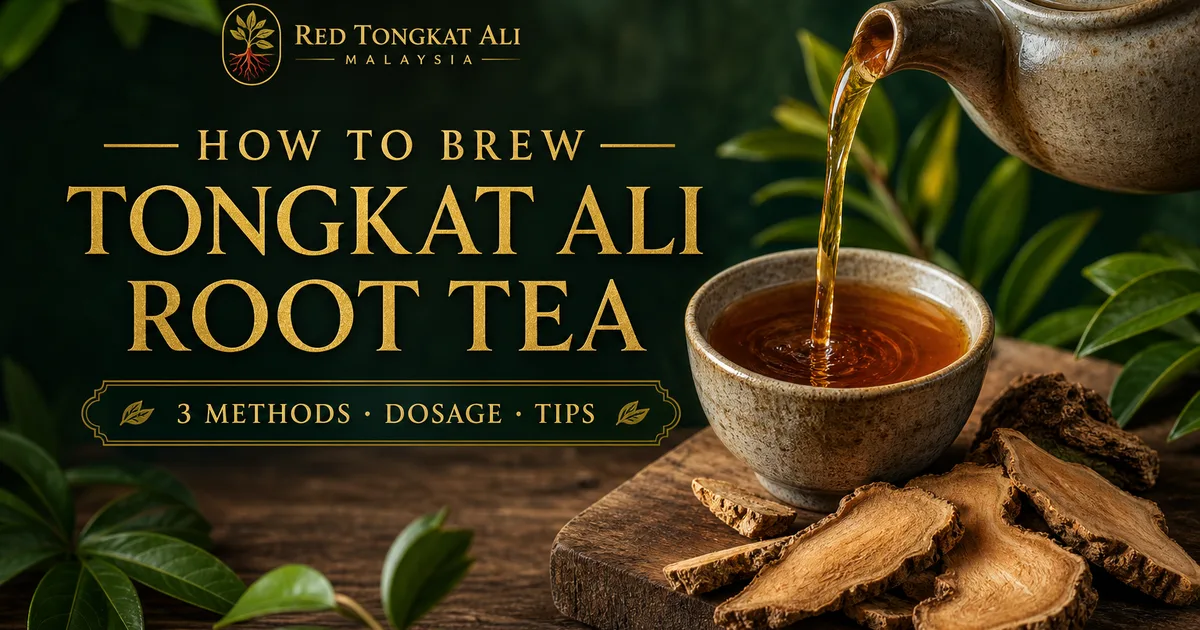
Red Tongkat Ali root slices being brewed in a traditional ceramic pot, producing deep amber tea

So your tongkat ali root slices have arrived — now what?

This guide covers everything you need to get started: three brewing methods ranked by effectiveness, the correct dose based on your age and sex, what to add to cut the bitterness, and honest answers to the questions most beginners get wrong.


What Are Tongkat Ali Root Slices, Exactly?

Each slice is a cross-section of dried Eurycoma longifolia root — also called longjack, pasak bumi, or Malaysian ginseng. Slices are typically 3–8 mm thick and 3–10 cm long. When you look at one, you’ll see:

  • Reddish-brown outer bark — the marker of the Red variety
  • Pale cream to amber interior — with visible growth rings like a tree cross-section
  • Dense, fibrous texture — hard and dry to the touch

Quick quality check: Touch the dry slice to your tongue. Authentic wild Red Tongkat Ali should be intensely bitter — significantly more so than black coffee. This bitterness comes from the active compounds: eurycomanone, glycosaponins, and quassinoids. Little to no bitterness is a red flag that the root is old, degraded, or not genuine.


Method 1: Traditional Boiled Tea (Best for Potency)

This is the method used in Malaysian villages for generations, and it extracts the highest concentration of active compounds. Start here.

What you need:

  • 2–3 root slices (per person, per day)
  • 500 ml–1 litre of filtered water
  • Small pot with a lid
  • Fine strainer or cheesecloth

Step-by-step:

  1. Place 2–3 slices in the pot with 500 ml of water.
  2. Bring to a boil over medium heat, lid on (this limits evaporation and concentrates the brew).
  3. Once boiling, reduce to a gentle simmer.
  4. Simmer for 20–30 minutes — the water will turn a deep amber-brown.
  5. Remove from heat and rest for 5 minutes.
  6. Strain into your mug or glass.
  7. Drink warm or at room temperature.

Re-brewing tip: The same slices can be boiled again up to 2–3 more times. Each re-brew produces lighter colour and less bitterness. Most users get 3–4 total brews from one set of slices before discarding them.

On the bitterness: It’s intense, and that’s correct. Add a teaspoon of honey — the most traditional remedy — or a squeeze of lemon. Do not add milk during the simmer; add it after straining if you prefer.


Method 2: Overnight Cold Soak (Best for Beginners)

A gentler extraction, lower bitterness, and no cooking required. Ideal for the first few weeks while your palate adjusts.

  1. Place 3–4 root slices in a glass jar or jug with 1 litre of cold filtered water.
  2. Cover and refrigerate overnight (8–12 hours).
  3. In the morning, the water will be lightly amber. Drink straight from the jar.
  4. Refill with fresh water during the day — the slices continue releasing compounds gradually.

The cold soak produces a noticeably milder drink than boiling and extracts fewer compounds per serving. It works well as a daily maintenance method once you’ve established the habit, but most experienced users eventually switch to the boiled method for better results.


Method 3: Large Batch Brewing (Best for Consistency)

Many users over 55 who want a simple daily routine brew once a week and refrigerate the batch. No daily preparation required.

  1. Add 8–10 slices to 3–4 litres of water in a large pot.
  2. Bring to a boil, then simmer gently for 45–60 minutes.
  3. Strain into clean glass bottles or a large jug.
  4. Refrigerate immediately — keeps well for 5–7 days.
  5. Drink one glass (150–200 ml) each morning.

The resulting brew is strong. If it tastes too intense, dilute it with water to taste. This is the most practical approach for people who travel or have busy schedules, since the preparation is done once and forgotten for the rest of the week.


Tongkat Ali Dosage Guide: By Age and Sex

There is no officially approved therapeutic dose — tongkat ali is a traditional herbal food, not a pharmaceutical. The guidance below reflects traditional Malaysian practice and what appears in published clinical research.

User ProfileDaily AmountNotes
Men 40–55, general use2–3 slicesStandard traditional dose
Men 55–652 slicesModerate; increase if well-tolerated after 2 weeks
Men 65–701–2 slicesStart at the lower end
Men 70+1 sliceConsult your doctor before starting
Women 40–551–2 slicesBegin with 1; increase slowly
Women 55–651 sliceStay conservative
Women 65+½–1 sliceConsult your doctor first

The most important rule: always start with 1 slice for the first one to two weeks, regardless of your age or the table above. This lets your body adjust and helps you identify your personal tolerance before increasing. Rushing the dose is the most common beginner mistake.


How to Make Tongkat Ali Tea Less Bitter

The bitterness is a feature, not a flaw — it’s the quality indicator. But there’s no reason to suffer through it. These additions are all compatible with the active compounds:

  • 🍯 Honey — the most traditional and popular choice; 1 teaspoon per mug is a good starting point
  • 🫚 Fresh ginger — add 2–3 thin slices to the pot while boiling; adds warmth and significantly reduces perceived bitterness
  • 🍋 Lemon juice — a squeeze after straining brightens the flavour and cuts through the earthiness
  • 🌶 Black pepper — a traditional Malaysian pairing; used in folk herbalism and believed by some practitioners to enhance absorption
  • 🥛 Milk or oat milk — not traditional, but a small splash after straining softens intensity for those who struggle most with the taste

What to avoid combining with tongkat ali:

  • Alcohol
  • High-caffeine drinks (energy drinks, very strong espresso) — potential for compounded stimulant effects
  • Other hormone-active supplements without medical advice

When to Take Tongkat Ali Tea

Morning is strongly preferred. Take your brew first thing, or alongside breakfast. Here’s why this matters:

Tongkat ali has mild stimulating properties. When taken in the morning, this aligns naturally with your waking hours and active day. When taken in the evening, a commonly reported side effect — difficulty falling asleep — becomes much more likely. The sleep issue is almost entirely avoided with morning use, and it is rarely raised by users who consistently brew in the morning.

Taking it at the same time each day also improves habit adherence, which matters for a supplement that takes weeks to show results.


How Long Does Tongkat Ali Take to Work?

One week is not enough time to evaluate. Allow 4–8 weeks of consistent daily use before drawing any conclusions. Most users in the 40+ age group report the first noticeable changes around weeks 4–6.

Tongkat ali is a long-term tonic, not a short-course treatment. The traditional approach is ongoing daily use, often for months or years. Many experienced users cycle it using one of these patterns:

  • 5 days on, 2 days off — the most common cycling approach
  • 3 weeks on, 1 week off — preferred by some users who are more sensitive
  • Daily without cycling — common among older traditional users, particularly in Malaysia

All three approaches are valid. Cycling may be more suitable for users over 65 or those who are sensitive to hormonal changes. There is no clinical evidence that cycling is strictly necessary for safety, but some users report that periodic breaks help maintain the perceived response over time.


Storage: Root Slices and Brewed Tea

Unbrewed root slices:

  • Sealed vacuum pack: store at room temperature, away from sunlight and moisture; good for 12–18 months
  • After opening: transfer to an airtight container in a cool, dry place
  • Used slices (between re-brews): store in the refrigerator

Brewed tea:

  • Refrigerate immediately after cooling
  • Batch brews: good for 5–7 days in glass bottles
  • Single-serve brews: best consumed the same day

Signs a slice has gone bad (uncommon in properly dried root): visible mould, sour or fermented smell, noticeably softened texture. If in doubt, replace the batch.


Common Questions from Beginners

The tea is extremely bitter. Is something wrong?

No. Intense bitterness is the expected quality marker for authentic wild Red Tongkat Ali. If it’s not bitter, that’s the actual problem. Add honey and continue.

How do I know when a slice is spent?

After 3–4 re-brews, a slice will produce nearly colourless water with minimal bitterness. That means the active compounds have been fully extracted — compost it and start fresh slices.

Can I mix tongkat ali tea with my morning coffee?

Many users do. If you find the combined stimulant effect too strong, try spacing them: tongkat ali tea first, then coffee 20–30 minutes later.

I’ve been drinking it for a week and don’t feel anything. Should I stop?

No. One week is too early to evaluate. Stay consistent for at least 4 weeks before making any judgement. Most users in the over-40 bracket begin noticing changes between weeks 4 and 6.

Can women take tongkat ali?

Yes. The dosage table above includes guidance for women. Women typically respond well to lower doses (1 slice daily). As with all herbal supplements, women who are pregnant, breastfeeding, or on hormonal medications should consult a doctor first.


Frequently Asked Questions (Quick Reference)

How long should I boil tongkat ali? 20–30 minutes for a standard brew; 45–60 minutes for a large weekly batch.

How many times can I reuse tongkat ali slices? Up to 3–4 times total before the slices are spent.

What does tongkat ali tea taste like? Intensely bitter, earthy, and slightly astringent — like very strong black tea crossed with bitter melon. Honey helps considerably.

Is the cold soak method as effective as boiling? No. Cold soaking extracts fewer active compounds per brew. It’s a gentler introduction, but the boiled method is more potent.

How much tongkat ali should a 60-year-old man take? Start with 1 slice daily for the first 1–2 weeks, then increase to 2 slices if well-tolerated. Consistent daily use for 4–8 weeks is needed to assess the effect.


Further reading: What Is Tongkat Ali? · Side Effects & Safety · Root Slices vs. Extract: Which Is Better?


Wild Red Tongkat Ali root slices — 500g or 1kg, shipped from Malaysia worldwide

View product and order →


⚠️ Disclaimer: This article is for educational and informational purposes only. Tongkat Ali is a traditional herbal food product, not a drug. It has not been evaluated by the FDA or equivalent regulatory bodies for the diagnosis, treatment, cure, or prevention of any disease. Always consult a qualified healthcare provider before starting any herbal supplement, particularly if you are on medication or have a pre-existing health condition.

Topics: how to brew tongkat alitongkat ali tea recipetongkat ali root teahow to make tongkat ali teatongkat ali dosage for men over 50tongkat ali for women dosagetongkat ali root slices how to usetongkat ali boiling methodtongkat ali cold brewlongjack tea recipeeurycoma longifolia teahow long to boil tongkat alitongkat ali taste bitter remedytongkat ali weekly batch brew
Try genuine wild Red Tongkat Ali from Malaysia

Raw root slices · Wild-harvested · Pahang, Malaysia 🇲🇾 · Ships worldwide · From $59.90