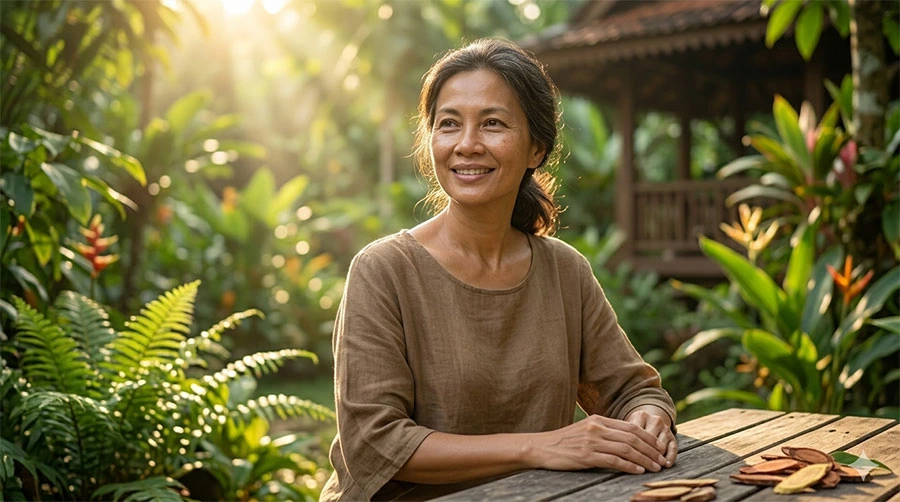
Almost all Tongkat Ali marketing is aimed at men. The imagery, the language, the promises — squarely at a male audience.
That leaves women with a question worth answering properly: Is Tongkat Ali actually relevant for me?
For many women over 40 — especially those navigating perimenopause, menopause, or the years that follow — the answer is yes. But the details matter, and they are almost never discussed honestly in the supplements space. This guide fills that gap.
Contents
- Why Testosterone Matters for Women Too
- What Happens During Perimenopause and Menopause
- How Tongkat Ali May Help Women
- What the Research Says
- Dosage for Women
- Important Safety Information
- Frequently Asked Questions
Why Testosterone Matters for Women Too
Testosterone is widely thought of as a male hormone. It is not — at least, not exclusively. Women produce testosterone in their ovaries and adrenal glands. Female testosterone levels are much lower than male levels, but they are biologically significant and play a meaningful role throughout adult life.
In women, healthy testosterone levels contribute to:
- Energy and stamina — adequate testosterone supports physical vitality, motivation, and endurance
- Libido — testosterone is one of the primary drivers of sexual desire in women, just as it is in men
- Mood and cognitive clarity — low testosterone is associated with low mood, brain fog, and difficulty concentrating
- Muscle tone and bone density — testosterone helps preserve both, which becomes increasingly important after 40
- Sense of drive and wellbeing — many women describe declining testosterone as losing their “spark”
When testosterone is discussed in the context of women’s health, it is often in clinical settings (such as testosterone therapy for low libido). The fact that women can naturally support their testosterone levels through lifestyle and herbal approaches is far less widely known.
What Happens to Hormones During Perimenopause and Menopause
Women’s testosterone levels begin declining in the mid-30s — before estrogen changes become prominent — and continue falling through perimenopause and into menopause. Estrogen gets most of the attention during this transition, but testosterone decline contributes meaningfully to several of the symptoms women find hardest to manage:
- Persistent fatigue — the kind that does not resolve with more sleep
- Low or absent libido — reduced sexual interest or diminished pleasure
- Flat mood or low motivation — difficulty feeling enthusiastic or emotionally resilient
- Irritability — a shorter fuse, often attributed entirely to estrogen changes
- Muscle loss and physical deconditioning — even with regular exercise
- Decreased confidence and sense of self — subtle but frequently reported
These experiences are often attributed entirely to estrogen. But declining testosterone is a parallel and often overlooked contributor — and unlike estrogen, it is rarely discussed as something women can actively support.
How Tongkat Ali May Help Women
Tongkat Ali (Eurycoma longifolia) is a root native to the rainforests of Southeast Asia, used for centuries in Malaysian and Indonesian traditional medicine. It works primarily through two mechanisms relevant to women:
- Supporting the body’s natural testosterone production — by reducing sex hormone-binding globulin (SHBG), which can make more testosterone biologically available
- Modulating cortisol — the stress hormone that suppresses testosterone when chronically elevated
Both mechanisms matter for women, not just men.

Wild-harvested Red Tongkat Ali root slices — the same preparation used in traditional Malaysian medicine
Energy and Fatigue Relief
The fatigue associated with perimenopause — that deep, pervasive tiredness that does not respond to rest — is one of the most common reasons women over 40 begin exploring herbal support. Tongkat Ali’s cortisol-lowering effect is particularly relevant here: chronically elevated cortisol is a major driver of energy depletion, disrupted sleep quality, and the sense of being “wired but tired.”
Libido and Sexual Interest
Declining sexual interest is one of the most common yet least openly discussed symptoms of hormonal change in women. Since testosterone directly influences libido, natural support for testosterone levels may help. It is also worth noting that traditional use of Tongkat Ali in Southeast Asia was not exclusively male — women used it too, and supporting libido was among its documented traditional applications.
Mood, Motivation, and Emotional Resilience
Many women who use Tongkat Ali describe a restoration of drive — not stimulation in the caffeine sense, but a more grounded sense of energy and motivation. The cortisol-balancing effect likely contributes: chronically high cortisol is strongly associated with anxiety, emotional depletion, and low mood. Reducing the cortisol burden can create more room for emotional equilibrium.
Muscle Tone and Bone Density Support
Testosterone plays a supporting role in maintaining both muscle mass and bone density in women. As levels decline through perimenopause, this becomes increasingly important — particularly for women at elevated risk of osteoporosis. While Tongkat Ali is not a dedicated bone supplement, supporting healthy testosterone levels as part of a broader wellness strategy may contribute to maintaining physical strength and skeletal health.
Cognitive Clarity
Brain fog — difficulty concentrating, memory lapses, mental sluggishness — is among the most disruptive perimenopause symptoms and is closely linked to hormonal changes. By supporting hormonal balance and reducing cortisol burden, Tongkat Ali may help some women maintain sharper cognitive function during this transition.
What the Research Says — For Women Specifically
The honest answer: most Tongkat Ali clinical research has involved male subjects. The evidence base for women is smaller — but it exists, and it is meaningful.
The most relevant study is Talbott et al. (2013), published in the Journal of the International Society of Sports Nutrition. This trial included both men and women — stressed adults of both sexes who took standardised Tongkat Ali extract for four weeks. Results showed significant reductions in cortisol and meaningful improvements in testosterone levels and self-reported wellbeing in both male and female participants.
This is the study that most directly supports the use of Tongkat Ali in women: its cortisol-lowering and testosterone-supporting effects are not sex-exclusive.
Beyond that trial, the evidence for women comes from:
- Centuries of traditional use in Malaysia and Indonesia, which included women
- Growing first-person reports from women who have used it consistently through perimenopause and beyond
- Plausible biological mechanisms — the pathways Tongkat Ali acts on are present in both sexes
We acknowledge the research gap honestly. More women-specific clinical trials are needed. What we can say is that the available evidence — limited as it is — supports relevance for women, not exclusion.
Dosage for Women: Start Lower, Go Slower
Women should use lower doses than men and increase gradually only after assessing their body’s response. The general principle: less is more when starting out.
| User Profile | Starting Dose | After 2–3 Weeks |
|---|---|---|
| Women 40–55, general vitality support | 1 slice per day | May increase to 2 slices if well-tolerated |
| Women 55–65 | 1 slice per day | Remain at 1 slice unless advised otherwise |
| Women 65+, or on any medications | ½ to 1 slice per day | Consult your doctor before increasing |
Preparation: Simmer 1 slice in 500ml (approximately 2 cups) of water for 20 minutes. Strain and drink in the morning, ideally before food.
The tea will be noticeably bitter — this is expected and reflects the active compounds in the root. Add raw honey to taste if needed. The bitterness is a quality indicator, not a defect.
See the full brewing and preparation guide →
Cycling: Many users cycle Tongkat Ali — 5 days on, 2 days off, or a monthly break — to prevent habituation. This is optional but reasonable for long-term use.
Important Safety Information for Women
Tongkat Ali is not appropriate for all women. Please read this section carefully before use.
Women Who Should NOT Use Tongkat Ali
- ❌ Pregnant or breastfeeding — no safety data exists for pregnancy; avoid entirely
- ❌ Hormone-sensitive breast cancer (current or past) — Tongkat Ali affects hormone levels; consult your oncologist
- ❌ Estrogen receptor-positive (ER+) cancers — same caution applies
- ❌ Polycystic ovary syndrome (PCOS) — women with PCOS frequently have elevated androgens; adding a testosterone-supporting herb without medical supervision is not advisable
- ❌ Currently taking hormonal contraceptives or HRT — potential interactions; discuss with your prescribing doctor first
Women Who Should Consult a Doctor First
- Women on any prescription medications
- Women with cardiovascular conditions or hypertension
- Women with autoimmune conditions (Tongkat Ali has mild immune-stimulating properties)
- Women over 65
For healthy women over 40 with no contraindications and no prescription medications, Tongkat Ali at a moderate dose is generally considered safe, based on traditional use spanning centuries and the available safety research.
Frequently Asked Questions
Will Tongkat Ali make me look or feel more masculine?
No. The testosterone-supporting effect at typical herbal doses is modest — it supports testosterone within a normal healthy female range, not beyond it. Healthy testosterone levels in women do not produce masculine characteristics. The amounts involved in traditional herbal use are nowhere near sufficient to cause virilisation.
How long before I notice any difference?
Consistent daily use for 4 to 6 weeks is typically needed before meaningful changes become apparent. This is not a supplement you will feel acutely after a single dose. Results are gradual and cumulative — most women who benefit report noticing changes in energy first, followed by mood and libido over subsequent weeks.
Can I take Tongkat Ali alongside my HRT or menopause supplements?
Discuss this with your doctor or pharmacist before combining. While there is no documented clinical interaction with standard HRT in the current literature, possible effects on hormone levels make professional guidance appropriate.
Will it affect my menstrual cycle?
Some women — particularly those who are pre-menopausal or in early perimenopause — report subtle cycle changes, particularly when starting. Others notice nothing. Start with a lower dose and monitor. If you notice unexpected cycle changes, reduce the dose or stop use and consult your doctor.
Is it safe to take every day long term?
Based on traditional use in Southeast Asian cultures, daily use appears safe for healthy adults without contraindications. For long-term use, a cycling approach (e.g., five days on, two days off) is reasonable.
What does “wild-harvested” mean, and why does it matter?
Wild-harvested root comes from plants growing naturally in their native forest habitat, rather than cultivated on plantations. This matters because Eurycoma longifolia grown in its natural highland environment — particularly the rainforests of Pahang, Malaysia — develops higher concentrations of the bioactive compounds responsible for its effects. Plantation-grown material is generally considered less potent.
Our Product
We source and sell wild-harvested Red Tongkat Ali root slices from the highland rainforests of Pahang, Malaysia — the same authentic, unprocessed root used in Malaysian traditional medicine for generations, shipped worldwide.
500g — $59.90 USD · 1kg — $119.90 USD
Order or ask a question via WhatsApp →
⚠️ Disclaimer: This article is for educational and informational purposes only. It does not constitute medical advice and should not be treated as such. Tongkat Ali is not approved by the FDA or any other regulatory body to treat, diagnose, cure, or prevent any disease or medical condition. Always consult a qualified healthcare provider before starting any new supplement — this is especially important if you have any history of hormone-sensitive conditions, are taking prescription medications, or are pregnant or breastfeeding.