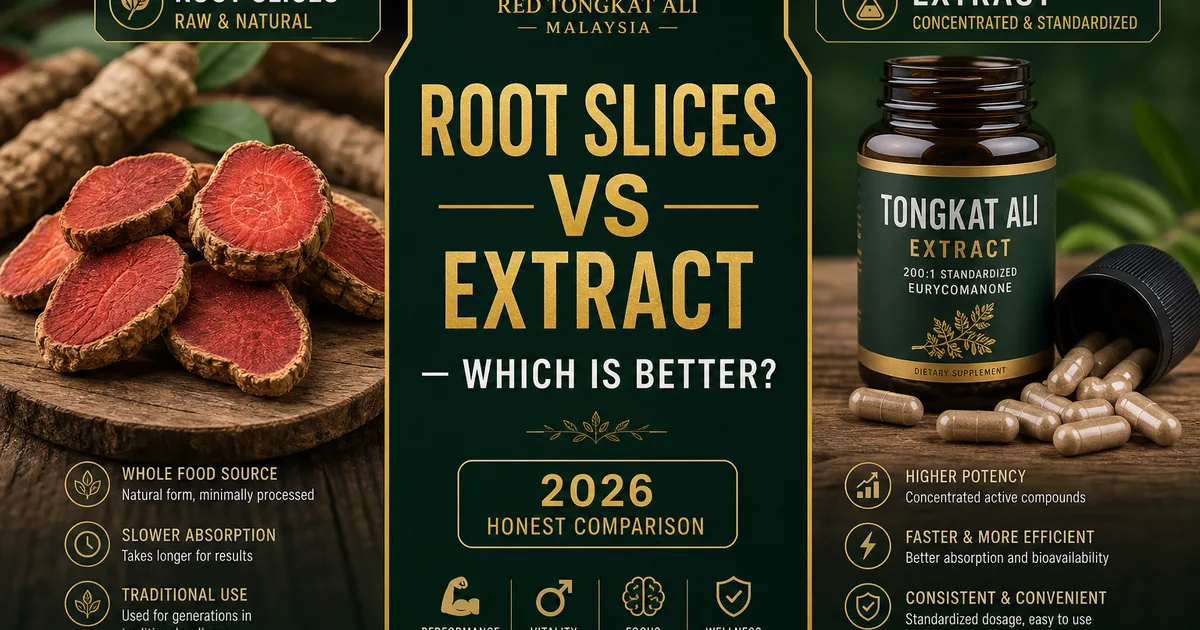
Choosing between raw Tongkat Ali root slices and a concentrated extract capsule is one of the most common questions we receive — and the answer is more nuanced than most supplement blogs suggest.
This guide breaks down every meaningful difference: potency, purity, cost per day, adulteration risk, clinical evidence, and traditional use. No hype in either direction.
What Each Product Actually Is
Raw Root Slices
Raw Tongkat Ali (Eurycoma longifolia) root slices are the cleaned, sliced, and dried root of the tree — nothing added, nothing removed. This is the form used in Malaysian and Indonesian traditional medicine for centuries, prepared by boiling in water and drinking as a tea.
Quality indicators are visible and verifiable: the reddish inner bark, the fibrous cross-section, and most importantly, a pronounced, clean bitterness that correlates with eurycomanone content.
Tongkat Ali Extract (Capsules or Powder)
Extracts are manufactured products. The process: dried root → water or solvent extraction → concentration → spray-drying into powder → encapsulation.
A “200:1 extract” label means 200 kg of dried root was processed down to 1 kg of powder. This sounds impressive. As we’ll explain, the ratio is frequently misunderstood — and sometimes deliberately misleading.
Head-to-Head: 7 Key Comparisons
1. Transparency and Verifiability
Raw root slices: You can see, smell, and taste what you’re buying. The reddish bark, fibrous texture, and bitterness are direct quality signals accessible to any buyer without laboratory equipment.
Extract capsules: You are trusting an opaque powder inside a capsule. Source country, root age, extraction method, and actual eurycomanone concentration are all invisible. Third-party certificates of analysis exist, but application across the industry is inconsistent — and certificate forgery is a documented problem in the broader herbal supplement market.
Verdict: Raw root wins on transparency. A root slice is physically very difficult to fake. A powder in a capsule is not.
2. Adulteration Risk and Market Quality Problems
Independent testing of commercial Tongkat Ali products has consistently identified:
- Incorrect species labelling (Yellow Eurycoma sold as Red)
- Eurycomanone content far below label claims
- Dilution with cheaper starches and fillers
- Elevated heavy metals in some Southeast Asian-manufactured extracts, linked to contaminated processing equipment
Raw root is not immune to quality issues — mislabelling of variety (red vs. yellow vs. black) exists — but those problems are often detectable through taste, colour, and appearance. Capsule adulteration is not.
Verdict: Raw root has a meaningful, practical advantage in quality detectability.
3. Full-Spectrum Profile vs. Isolated Compounds
Extraction targets the bioactive compounds currently associated with Tongkat Ali’s effects: primarily eurycomanone, glycosaponins, and eurypeptides.
However, phytochemical research on Eurycoma longifolia is ongoing. The full complement of bioactive compounds in the root has not been characterised. Some researchers argue for synergistic effects from whole-root preparations — a reasonable hypothesis supported by how other adaptogenic plants function, but not yet conclusively proven in clinical trials for Tongkat Ali specifically.
Extracts offer measurable standardisation of known compounds. Raw root offers the full natural profile, including unknowns.
Verdict: Tie with different trade-offs. Neither approach is clearly superior here; it depends on whether you prioritise measurable standardisation or full-spectrum coverage.
4. Does “200:1” Actually Mean Stronger?
This is the most important thing to understand about extract marketing, and the most commonly misunderstood.
A 200:1 ratio describes the manufacturing input-to-output ratio — not the potency of the final product. It tells you nothing about:
- The quality or age of the starting root (3-year farmed root vs. 10-year wild-harvested root)
- The actual eurycomanone concentration in the powder
- Whether heat-sensitive compounds were preserved during processing
- Whether the ratio refers to wet weight, dry weight, or something else
A low-quality farmed root concentrated at 200:1 does not automatically produce a stronger product than a mature wild-harvested root brewed directly. Quality of starting material matters at least as much as concentration ratio.
Verdict: The 200:1 number is not a reliable quality indicator. Ask for eurycomanone % content instead.
5. Cost Per Day of Use
This is where many buyers are surprised. Raw root is widely assumed to be the expensive, specialist option. The reality:
| Product | Price | Daily Use | Supply | Cost/Day |
|---|---|---|---|---|
| 200:1 extract capsules (60 caps) | $25–45 | 2 capsules | 30 days | $0.85–$1.50 |
| Raw root slices, 500g | $59.90 | 5–8g (2–3 slices) | 90–120 days | $0.50–$0.65 |
| Raw root slices, 1kg | $119.90 | 5–8g (2–3 slices) | 180–240 days | $0.50–$0.65 |
Wild raw root slices are typically cheaper per day of use than commercial extracts, and considerably cheaper at the 1 kg size.
Verdict: Raw root wins on cost-per-day value.
6. Clinical and Traditional Evidence
Clinical research base: Almost all published clinical trials — including the most-cited studies on testosterone support, stress adaptation, and physical performance — have used standardised water-soluble extracts, typically from the Malaysian Tongkat Ali industry. The direct evidence base is for extracts.
Traditional evidence base: Centuries of consistent use of boiled whole root across Malaysia, Indonesia, and Thailand, with documented effects that align with what is now being studied scientifically. Notably, the traditional preparation method (boiling root in water) is chemically equivalent to the water extraction process used to make most commercial extracts.
Verdict: Extracts have more direct clinical evidence. Raw root has the longer, broader traditional evidence base. Which you weight more is a values decision.
7. Convenience
Extract capsules: Two capsules with water. No preparation required, no taste to manage, easy to travel with.
Raw root slices: 20–30 minutes of simmering, active attention required, a bitter tea that takes adjustment. Not practical for frequent travellers.
Verdict: Extracts win on convenience. For many people, this is the deciding factor, and that’s a completely reasonable position.
Common Mistakes When Buying Either Form
Regardless of which form you choose, these are the most frequent buying errors:
For extracts:
- Buying based on extraction ratio (200:1, 400:1) without checking eurycomanone % — the ratio is meaningless without it
- Choosing the cheapest option on Amazon without verifying third-party lab testing
- Not checking where the root was sourced (Malaysian E. longifolia has the strongest research base)
For raw root:
- Buying without verifying the variety — Red (E. longifolia) is the traditionally used, most-studied form
- Choosing overly cheap root without asking about harvest age (roots under 5 years have significantly lower active compound content)
- Inconsistent brewing — the preparation method affects extraction yield
Which Should You Choose?
Choose Extract If:
- Convenience is your primary requirement
- You travel frequently
- You prefer measurable, standardised compound levels
- You’ve found a brand with transparent third-party testing
Choose Raw Root If:
- You want to verify quality directly through taste and appearance
- You prefer the traditional whole-food preparation method
- Cost efficiency over a 3–6 month period matters
- You want the full-spectrum natural profile, including uncharacterised compounds
- You’re prepared to invest 20–30 minutes in daily preparation
Frequently Asked Questions
Is raw Tongkat Ali root more potent than capsules?
Not necessarily — potency depends more on root quality and age than on form. A mature wild-harvested root brewed correctly can be more potent than a low-quality farmed root in a 200:1 extract capsule. The form alone doesn’t determine potency.
What eurycomanone percentage should I look for in an extract?
Reputable standardised extracts typically contain 0.8%–2% eurycomanone by dry weight. Products above 2% exist but should be verified by independent lab testing. Always ask the supplier for a certificate of analysis.
How long should I take Tongkat Ali before seeing results?
Most users in clinical studies and traditional use report noticeable effects after 4–6 weeks of consistent daily use. Benefits related to testosterone and cortisol adaptation may take longer to stabilise.
Can I take Tongkat Ali every day?
Traditional use involves daily consumption. Some practitioners recommend a cycling approach (e.g., 5 days on, 2 days off) to prevent tolerance, though clinical evidence for this specific protocol is limited.
Is Malaysian Tongkat Ali better than Indonesian?
Malaysian and Indonesian Eurycoma longifolia are the same species. Most clinical research has used Malaysian-sourced material, particularly from Pahang state, which is why Malaysian origin is often cited as a quality signal. Indonesian sources can be equally high quality but have less published research behind them.
What does Tongkat Ali taste like?
Genuinely very bitter — this is expected and is actually a quality indicator. Eurycomanone, the primary active compound, is intensely bitter. A root or tea that tastes mild or has no bitterness is likely low quality or adulterated.
Our Position
We sell raw root slices sourced directly from wild-harvested forests in Pahang, Malaysia — so our preference is not a secret. But we’ve tried to give a fair account of both options above.
If convenience is your priority and you find a well-tested extract from a transparent supplier, it is a completely valid choice. We sell raw root because we believe in the original form: the one that has centuries of traditional use behind it, the one you can verify yourself through taste and appearance, sourced from a supply chain we know personally.
Wild Red Tongkat Ali root slices — Pahang, Malaysia 500g — $59.90 USD · 1kg — $119.90 USD
How to Brew Tongkat Ali Root → | What Is Tongkat Ali? → | Shop →
Disclaimer: This article is for educational purposes only and does not constitute medical advice. Consult a qualified healthcare provider before starting any new supplement, particularly if you have a pre-existing health condition or are taking medication.