If you have been hearing the name Tongkat Ali lately — on a men’s health podcast, a supplement subreddit, or in a conversation about natural alternatives to prescription hormone therapy — you are far from alone.
Google searches for “tongkat ali” have grown by over 300% in the past three years across the United States, United Kingdom, Canada, and Australia. But interest has outpaced accurate information. Misleading product labels, inflated claims, and poor-quality imports have muddied the picture considerably.
This guide gives you the complete, honest answer — what Tongkat Ali actually is, what the research shows (and doesn’t show), who it may help, and how to identify genuine quality.
What Is Tongkat Ali? (The Short Answer)
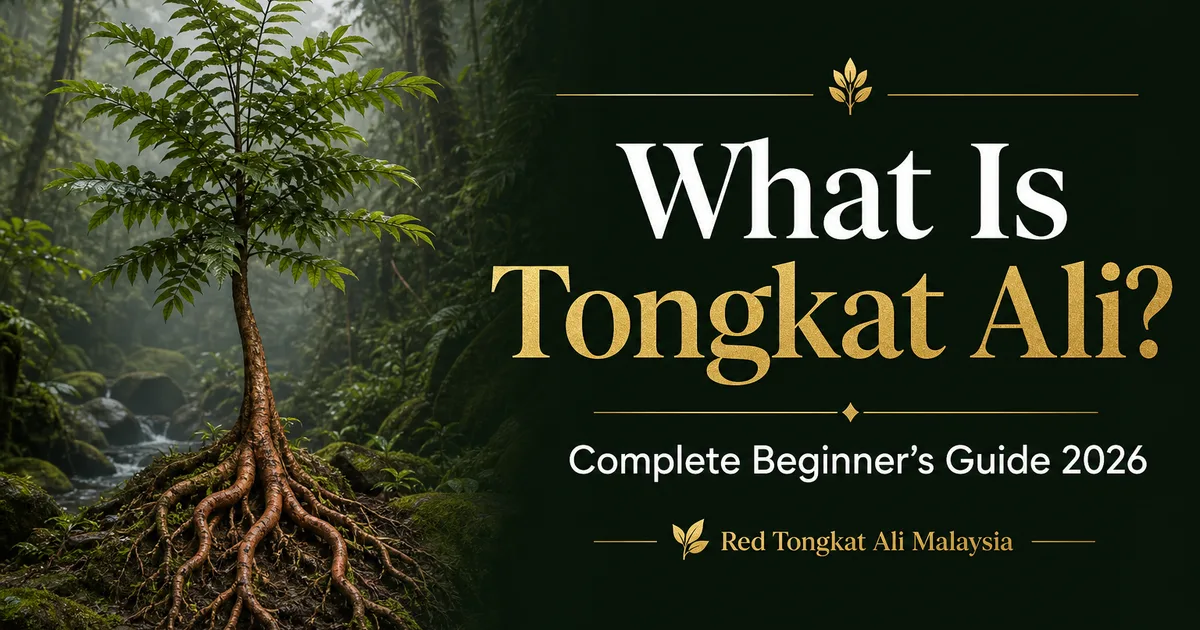
Tongkat Ali (Eurycoma longifolia) is a slow-growing medicinal tree native to the tropical rainforests of Southeast Asia. Its long, woody, intensely bitter root has been used in Malaysian and Indonesian traditional medicine for centuries as a daily vitality tonic, a fatigue remedy, and a support for male reproductive health.
In Western supplement markets, it is most commonly sold as a testosterone support herb — though its mechanisms are more nuanced than that label suggests.
Where Does Tongkat Ali Come From?
Tongkat Ali grows wild across Malaysia, Indonesia, Thailand, Vietnam, and the Philippines. Its medicinal heartland is peninsular Malaysia — particularly the deep highland rainforests of Pahang, Kelantan, and Perak, where the combination of altitude, humidity, and acidic soil produces roots with the highest concentration of bioactive compounds.
The name itself is revealing: tongkat means “walking stick” and Ali is a common Malay male name — roughly translated as “Ali’s walking stick,” a folk reference to the root’s reputation for keeping older men strong and physically capable well into later life.
Wild-harvested Malaysian root is considered the gold standard. Plantation-grown root from lower-altitude regions (including some Indonesian sources that dominate the bulk supplement market) typically yields lower potency.
The Three Varieties: Red, Yellow, and Black
There are three traditionally recognised varieties, distinguished by the colour of the bark:
| Variety | Species | Rarity | Traditional Status |
|---|---|---|---|
| Yellow | Eurycoma longifolia | Common | Standard daily tonic |
| Red | Eurycoma longifolia (highland ecotype) | Uncommon | Reserved for strongest tonic effect |
| Black | Polyalthia bullata | Rare | Found mainly in Borneo |
Red Tongkat Ali — harvested from highland forests at elevation — is considered the most potent variety by traditional Malaysian practitioners. It grows more slowly under harsher conditions, which traditional wisdom (and some emerging research) suggests leads to a higher accumulation of active compounds like eurycomanone and quassinoids.
The majority of Tongkat Ali sold in Western supplement markets is Yellow variety, often blended or mislabelled. Red highland root is significantly harder to source at scale.
→ Full variety comparison: Red vs Yellow vs Black Tongkat Ali
Traditional Uses Across Generations
The Orang Asli — the indigenous peoples of peninsular Malaysia — have the longest documented relationship with this root. For them, Tongkat Ali was not a supplement; it was woven into daily life across generations.
Documented traditional uses across Malaysian, Indonesian, and Thai folk medicine include:
- Daily vitality tonic — brewed as a bitter morning tea by men of all ages to sustain energy and physical strength
- Post-illness recovery — given during convalescence to rebuild strength and appetite
- Male reproductive health — one of its oldest and most consistent traditional applications, supporting libido and sexual vigour
- Sustained physical endurance — consumed by hunters, forest workers, and farmers for all-day stamina
- Stress resilience and mental clarity — used to maintain emotional stability and focused thinking
The preparation was always simple: boil the root in water for 15–30 minutes, drink the tea, and discard or re-brew the root. No processing, no additives.
→ Full brewing guide with dosage
What Does the Science Actually Say?
Scientific investigation of Tongkat Ali began in earnest in the 1990s at Malaysian universities and has since expanded globally. Here is what the most credible studies have found — along with honest caveats.
1. Testosterone and Hormonal Support
The most frequently cited study (Tambi et al., Asian Journal of Andrology, 2012) followed 76 men with late-onset hypogonadism (clinically low testosterone). After one month of standardised Tongkat Ali extract, the proportion of men with normal testosterone levels rose from 35.5% to 90.8%.
A 2021 randomised, double-blind, placebo-controlled trial (George et al., Phytotherapy Research) in 105 men aged 50–70 found statistically significant improvements in testosterone levels, sexual performance scores, and fatigue measures after 12 weeks.
Important nuance: Tongkat Ali appears to work primarily by reducing sex hormone-binding globulin (SHBG) and supporting the hypothalamic-pituitary-gonadal (HPG) axis — meaning it may help the body produce and utilise testosterone more efficiently, rather than introducing testosterone externally. This is a meaningful distinction from synthetic hormone therapies.
2. Cortisol Reduction
A 2013 study (Talbott et al., Journal of the International Society of Sports Nutrition) found that Tongkat Ali significantly reduced cortisol exposure and improved testosterone-to-cortisol ratio in moderately stressed adults — in both men and women.
This matters because chronically elevated cortisol is a primary suppressor of testosterone production. If stress is a factor in hormonal decline (which it commonly is in adults over 40), addressing cortisol may be a central mechanism.
3. Physical Performance and Muscle
Several small trials in older adults found measurable improvements in grip strength, lean muscle mass, and physical performance scores after 4–12 weeks of consistent use. A 2014 study (Journal of the International Society of Sports Nutrition, Hamzah & Yusof) found that recreational athletes using Tongkat Ali gained more lean mass and lost more fat compared to placebo over five weeks.
Honest Caveats
- Most studies use standardised extracts at specific concentrations — not raw root slices. Dosage equivalencies between whole root and extract are not well-established.
- Sample sizes in most trials are small (fewer than 150 participants).
- Long-term safety studies beyond 6 months are limited.
- Effects appear most pronounced in men who already have suboptimal testosterone — not men with healthy baseline levels.
→ Raw root vs. standardised extract — a detailed comparison
How Does Tongkat Ali Work? (The Mechanisms)
Tongkat Ali contains several classes of bioactive compounds, the most studied of which are:
- Eurycomanone and related quassinoids — bitter compounds unique to Eurycoma longifolia; associated with testosterone and cortisol effects
- Eurypeptides — short protein chains thought to support ATP production and energy metabolism
- Glycosaponins — compounds associated with adaptogenic and physical performance effects
- Alkaloids — including beta-carboline alkaloids with potential mood and cognitive effects
The leading proposed mechanisms:
- Inhibiting SHBG (sex hormone-binding globulin), increasing free testosterone availability
- Stimulating Leydig cell activity in the testes (supporting endogenous testosterone production)
- Reducing cortisol through adrenal modulation
- Supporting mitochondrial function and ATP synthesis (the energy-related effects)
No single mechanism fully explains the range of effects reported. This complexity is part of why the whole root — with its full spectrum of compounds in natural ratios — may behave differently from isolated extracts.
Who Is Tongkat Ali Most Likely to Help?
Based on current evidence and traditional use, the people most likely to notice meaningful effects are:
- Men 40–70 experiencing age-related decline in energy, drive, strength, or libido — particularly those with suboptimal (rather than critically low) testosterone
- Women 40+ navigating perimenopause or menopause — for energy, mood stability, and reduced fatigue (the cortisol-reduction pathway is gender-neutral)
- Adults under chronic stress where elevated cortisol is suppressing hormonal balance
- Physically active adults over 45 looking to support muscle maintenance and recovery
- People preferring whole-food herbal approaches before considering pharmaceutical interventions
Tongkat Ali is unlikely to produce noticeable effects in younger men with healthy testosterone levels, or in anyone expecting immediate stimulant-like results.
→ Tongkat Ali for Men Over 50 | Tongkat Ali for Women
Raw Root Slices vs. Capsule Extracts: Why It Matters
The overwhelming majority of Tongkat Ali sold in Western markets is “standardised extract” — the root boiled down, concentrated, spray-dried into powder, and encapsulated. Labels typically read “200:1 extract” or “standardised to X% eurycomanone.”
Raw root slices are different: the actual dried root, cut into pieces. Nothing concentrated, nothing removed, nothing added.
The case for raw root:
Transparency. You can see, smell, and most importantly taste what you have. Genuine Tongkat Ali is intensely bitter — almost unpleasantly so. This bitterness comes from the same eurycomanone compounds associated with its effects. A root with no bitterness is either weak, old, or adulterated. With powder in a capsule, you cannot assess quality at all.
Full-spectrum profile. Researchers have not yet identified every bioactive compound in Eurycoma longifolia. Standardised extraction targets known compounds (primarily eurycomanone) but inevitably discards others — including eurypeptides, glycosaponins, and alkaloids — whose contributions may not be fully understood. Raw root retains everything in naturally occurring ratios.
Validated historical method. Boiling root in water is how this herb has been consumed for centuries. It is the method with the longest safety record and the most accumulated traditional knowledge. No extraction solvents, no processing aids, no fillers.
Adulteration risk. The Tongkat Ali supplement market has a documented adulteration problem. Third-party testing has repeatedly found capsule products containing little to no actual eurycomanone — or spiked with undisclosed pharmaceutical compounds. Raw root slices are significantly harder to adulterate meaningfully.
What to Realistically Expect
Tongkat Ali is not a stimulant. It does not produce an immediate effect like caffeine or a pre-workout compound. The traditional approach — and the longer clinical studies — consistently suggest that 4–8 weeks of daily use is the minimum timeframe for meaningful changes to accumulate.
What consistent users commonly report (individual results vary significantly):
- Weeks 1–2: Subtle shift in morning energy quality; some users report improved sleep depth
- Weeks 3–4: Gradual increase in motivation and drive; reduced afternoon fatigue
- Weeks 5–8: Increased libido; improved sense of physical vitality; some users note improved mood stability
What it does not typically produce: dramatic rapid changes, stimulant-like energy spikes, or effects comparable to prescription testosterone therapy.
Take it in the morning. Late-day consumption can cause restlessness or difficulty sleeping in some users, particularly at higher doses.
Safety and Side Effects
For healthy adults, Tongkat Ali has a well-established safety record across centuries of traditional use and multiple clinical trials. It is generally well-tolerated.
Most common side effects (typically dose-related and reversible):
- Insomnia or restlessness — most common, especially with late-day use or high doses
- Mild irritability during the first week of use
- Increased body temperature (reported by some users)
Who should not use Tongkat Ali:
- Pregnant or breastfeeding women
- Anyone with hormone-sensitive cancers (prostate, breast, ovarian)
- Children and adolescents
Consult your doctor first if you:
- Take prescription medications (particularly those affecting hormones or blood pressure)
- Have cardiovascular, liver, or kidney conditions
- Have a history of sleep disorders
→ Full safety and side effects guide
Frequently Asked Questions
Is Tongkat Ali the same as Longjack?
Yes. “Longjack” is the most common English trade name for Eurycoma longifolia. Other names include Malaysian ginseng, pasak bumi (Indonesian), and tongkat ali (Malay). They all refer to the same plant.
How does Tongkat Ali compare to Ashwagandha?
Both are adaptogens used for stress resilience and vitality, but they work through different mechanisms. Ashwagandha (Withania somnifera) primarily reduces cortisol and has stronger evidence for anxiety reduction and sleep quality. Tongkat Ali has stronger evidence for testosterone support specifically. Many adults over 40 use both, though little research exists on combined use.
Can women take Tongkat Ali?
Yes. The cortisol-reduction and energy-support effects are not gender-specific. Some women report improved energy, mood, and libido during perimenopause. Dosage for women is typically lower than for men. Avoid during pregnancy and breastfeeding.
How long until I notice effects?
Most users report first noticing changes in energy and motivation between weeks 3–5. Libido and physical performance changes tend to emerge later, around weeks 6–8. Effects are cumulative and gradual, not immediate.
Can I take Tongkat Ali every day?
Traditional use was daily and continuous. Some practitioners recommend cycling (e.g., 5 days on, 2 days off) to prevent adaptation, but there is no strong clinical evidence that cycling is necessary. Experiment to find what works for you.
What is the recommended dosage?
For standardised 200:1 extract: commonly 200–400mg per day. For raw root tea: 1–3g of dried root per brew. Always start at the lower end and assess tolerance over 2–3 weeks before increasing.
How to Identify Quality Tongkat Ali
Whether you are buying extract or raw root, apply these filters:
- Origin matters — look for Malaysian highland origin (Pahang, Kelantan, or Perak); avoid products with no stated origin
- Third-party testing — reputable suppliers publish COAs (certificates of analysis) from independent labs confirming eurycomanone content and absence of heavy metals
- Bitterness (for raw root) — genuinely potent root is intensely, almost unpleasantly bitter; no bitterness means low potency
- No undisclosed additives — the Tongkat Ali market has a documented history of adulteration; buy from suppliers who test for pharmaceutical spiking
- Transparent sourcing — know whether it is wild-harvested or plantation-grown; wild highland root is generally considered superior
Our Sourcing
Our roots are sourced directly from experienced wild-harvesters in the highland rainforests of Pahang, Malaysia — the traditional heartland of Red Tongkat Ali. We do not use plantation-grown roots. We do not mix varieties or origins.
Each batch follows a simple chain: wild-harvested → hand-cleaned and sliced → naturally dried → vacuum-sealed → shipped direct from Malaysia.
Ready to try genuine wild Red Tongkat Ali? Order from $59.90 →
Summary
| Botanical name | Eurycoma longifolia |
| Origin | Peninsular Malaysia (wild highland forests) |
| Part used | Root |
| Traditional use | Daily vitality tonic, fatigue remedy, male reproductive health |
| Primary mechanisms | SHBG reduction, cortisol suppression, HPG axis support |
| Best evidence | Testosterone support, cortisol reduction, fatigue improvement |
| Who benefits most | Adults 40–70 with suboptimal testosterone or chronic stress |
| Time to effect | 4–8 weeks of consistent daily use |
| Safety | Well-tolerated; avoid in pregnancy, hormone-sensitive cancers |
⚠ Disclaimer: This article is for educational purposes only and does not constitute medical advice. Tongkat Ali is not approved by the FDA, MHRA, TGA, or Health Canada to diagnose, treat, cure, or prevent any disease. Always consult your physician before starting any herbal supplement, particularly if you take prescription medications or have existing health conditions.