
Blog
Wild vs Farmed Tongkat Ali: Why Origin Labels Don't Prove Potency
Wild vs farmed Tongkat Ali: what origin labels can and can't prove — root-age narratives, eurycomanone research limits, and what labels hide.
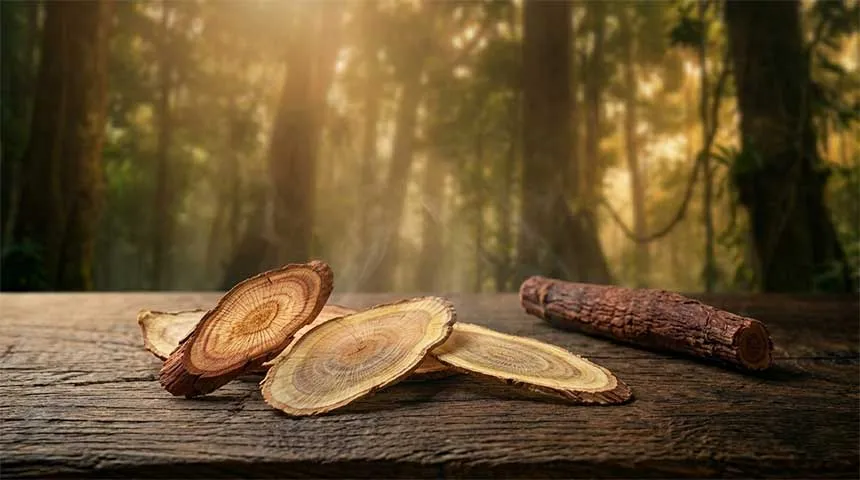
Is wild Tongkat Ali more potent? There's no product-specific evidence that wild root tea is more potent or clinically more effective than farmed material. "Wild" and "farmed" are sourcing descriptions — only appropriate batch testing could characterise identity, purity, and composition.
The wild-versus-farmed comparison is often presented as a simple quality ladder: wild is said to be older and stronger, cultivated material weaker. That story sounds intuitive, but it combines several separate questions — provenance, plant identity, harvest practices, chemistry, sustainability, and clinical effect. None of them can be settled by the word “wild” alone.
What the Labels Actually Describe
“Wild-harvested” means a seller says the material was collected from a non-cultivated setting; “farmed” or “cultivated” means it was grown under some form of managed production. Neither term is a laboratory result. Making a sourcing claim meaningful would require a supply chain with records connecting the collected material to a place, date, supplier, and batch — a product photo or forest image can’t independently provide that chain. The labels alone don’t verify botanical species, root age, contaminants, a marker-compound concentration, or a health effect.
Why Age and Appearance Don’t Resolve Potency
Older roots are frequently marketed as stronger, but a claimed age is not a measurement unless reliable harvest records support it. Visible rings in a cut root can be a descriptive feature, but counting them isn’t a validated method for establishing age or chemistry. Colour, density, aroma, and bitterness are sensory observations that describe what a buyer received — they don’t identify a species or quantify a constituent. A bitter tea isn’t automatically a more effective tea, and the same caution applies to geography: “Pahang,” “highland,” or “rainforest” are sourcing context, not a potency certificate.
What Human Research Contributes
Human research on Eurycoma longifolia has generally evaluated selected standardized extracts, not direct comparisons of wild and farmed root teas. A 2022 systematic review of testosterone-related outcomes shows why the exact studied material matters: PubMed 36013514. That evidence can’t answer whether wild root tea outperforms cultivated root tea, and it can’t determine the dose, chemistry, or safety of our slices. The governing boundary remains: extract study, root tea, and this batch are three different things.
Sustainability and Potency Are Different Questions
Sustainable, lawful sourcing matters even when it says nothing about clinical effectiveness — poorly controlled wild collection can pressure slow-growing plants and ecosystems, while “farmed” alone doesn’t guarantee good agricultural practice. A responsible buying decision can ask: is the stated source legal and documented? Can the seller connect the batch to the claimed source? What identity and contaminant testing is available? It’s possible to value a sourcing tradition while still acknowledging that origin doesn’t prove potency.
Our Product Boundary
We describe our slices as Pahang-sourced dried root sold as a food for brewing. We don’t publish a batch certificate of analysis, DNA identification, harvest-age documentation, or measured eurycomanone concentration — buyers shouldn’t infer batch verification from our trade language, photographs, colour, or aroma. Current documentation limits: what we test.
How to Compare Products More Responsibly
For either wild or cultivated products, compare like with like: confirm whether it’s root slices, powder, or extract; look for a batch identifier rather than a generic report; check whether any lab document actually matches that batch; and reject guaranteed outcome or onset claims. An extract with documented specifications and root slices without them answer different buyer needs — neither should borrow the other’s evidence.
Bottom Line
“Wild” and “farmed” can describe a sourcing model, but neither term establishes potency, safety, or health effect. Direct human comparisons of the two root-tea formats aren’t available. Use the evidence index to separate research from product proof, and evaluate each batch by the documentation actually provided.
Related: Authentic Malaysian Tongkat Ali · Where Does Tongkat Ali Come From? · What We Test
Educational information, not medical advice. This product has not been evaluated by the FDA and is not intended to diagnose, treat, cure, or prevent any disease.
Frequently asked questions
Does wild always mean older?
Can bitterness distinguish wild from farmed roots?
Are cultivated roots inferior?
Is a wild product safer?
Do you publish a lab test or COA for your Tongkat Ali?
Where can I buy Red Tongkat Ali root slices in the USA?
Ready to brew the real root?
500g, 1kg or 2kg of Malaysian Red Tongkat Ali root slices — tracked shipping to the USA included. Pay by card or USDT (5% off).
Shop root slicesLost or damaged? Free reship · Secure Stripe checkout · One-time purchase, no subscription